Home batteries have shifted from a nice-to-have to a must-have investment for Australian households in 2025. Rising electricity prices, more frequent blackouts, extreme weather events, and new federal battery rebates from July 2025 have accelerated adoption across the country.
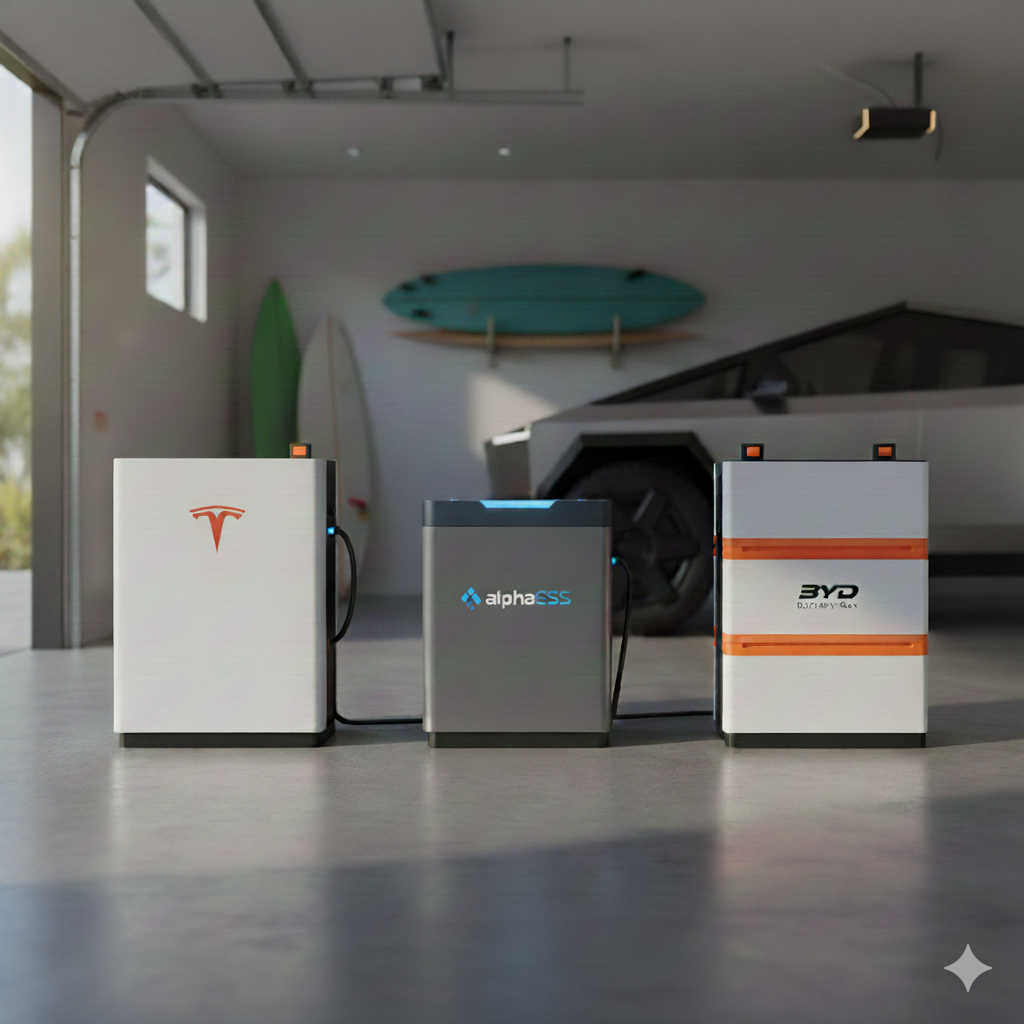
Among all options, Tesla Powerwall, AlphaESS and BYD consistently dominate searches like “best solar battery Australia 2025”, “Tesla Powerwall vs BYD” and “AlphaESS vs Tesla Powerwall”. This in-depth comparison breaks down performance, price, warranty, software, backup capability and real-world suitability so you can confidently choose the best battery for your home.
Why Tesla, AlphaESS and BYD Dominate the Australian Battery Market in 2025
These three brands appear most often on installer recommendation lists and government-approved battery programs because they:
Are well-tested in Australian climate conditions
Use safe and durable LFP (Lithium Iron Phosphate) chemistry
Integrate with popular inverters and solar systems
Offer 10-year warranties with strong local support
Brand positioning at a glance
Tesla Powerwall – Premium, all-in-one solution with best-in-class software
AlphaESS – Value-driven battery with strong rebates and fast payback
BYD – Modular, scalable system ideal for larger and future-ready homes
Battery Specs Comparison: Capacity, Power & Chemistry
Tesla Powerwall 3 (Australia – 2025)
Tesla Powerwall 3 is an all-in-one home battery with integrated solar capability, now using LFP chemistry for improved safety and longevity.
Key specs:
Usable capacity: ≈13.5 kWh
Continuous power output: ≈11–14 kW
Chemistry: LFP (Lithium Iron Phosphate)
Coupling: AC-coupled with integrated solar inverter (hybrid-style)
Ideal for homeowners wanting simplicity, high power output and premium software.
AlphaESS Residential Battery Systems
AlphaESS offers multiple residential models (Smile series), designed for affordability while still delivering solid performance.
Key specs:
Capacity range: ≈5 kWh to 35 kWh (modular)
Chemistry: LFP
Coupling: Primarily DC-coupled via hybrid inverters (AC options also available)
AlphaESS systems are commonly chosen for budget-conscious households seeking good ROI.
BYD Battery-Box Premium Series
BYD is known for its highly modular and scalable battery systems, widely used in both residential and light commercial installs.
Key specs:
Starting capacity: ≈7–10 kWh
Expandable: 20–60+ kWh depending on configuration
Chemistry: LFP
Coupling: DC-coupled via compatible hybrid inverters (Fronius, Sungrow, etc.)
BYD is ideal for homes planning future expansion, EV charging or full electrification.
AC vs DC Coupling – Why It Matters
Tesla Powerwall (AC-coupled) is ideal for retrofits, working seamlessly with existing solar systems.
AlphaESS and BYD (mostly DC-coupled) are more efficient in new solar + battery installations, reducing conversion losses.
Simple rule:
Retrofitting an existing system → Tesla Powerwall
New solar + battery build → AlphaESS or BYD
Backup Power & Blackout Protection
Tesla Powerwall Backup
Automatic switchover during outages
High surge power for fridges, pumps and air conditioners
Optional whole-home backup (design dependent)
Features like Storm Watch enhance resilience
AlphaESS Backup Capability
Backup via hybrid inverter (EPS or essential-load circuits)
Reliable protection for critical appliances
Cost-effective entry into blackout resilience
BYD Backup Performance
Backup strength depends on inverter choice
Excellent for three-phase and larger homes
Highly flexible system design for rural or outage-prone areas
Verdict: Tesla leads for simplicity, BYD excels for complex or large systems.
Software, Monitoring & Smart Features
Tesla Powerwall App
Market-leading mobile app
Real-time solar, battery and consumption data
Backup reserve and weather-aware charging
Seamless ecosystem with Tesla EVs
AlphaESS Monitoring Platform
Functional and improving app
Live and historical energy data
Strong VPP compatibility (VIC & SA)
BYD Software Experience
Uses inverter-based platforms (Fronius, Sungrow, etc.)
Extremely powerful for advanced users
Slightly more complex for everyday homeowners
Warranty, Reliability & Lifespan
All three brands offer:
10-year product warranties
Capacity retention guarantees (≈70–80%)
Proven LFP chemistry for long cycle life
Installer feedback in 2025 continues to rate Tesla, AlphaESS and BYD among the most reliable battery brands in Australia.
Price Comparison & 2025 Battery Rebates (Australia)
Tesla Powerwall Pricing
Installed price: ≈$9,900–$11,500 after rebates
Premium cost per kWh
AlphaESS Pricing
Installed price: ≈$5,000–$6,500 for ~10 kWh after rebates
One of the fastest payback batteries in Australia
BYD Pricing
Mid-range pricing
Usually cheaper than Tesla per kWh
Slightly higher than AlphaESS depending on inverter
Federal Battery Rebates (From July 2025)
Up to 30% upfront discount
Applies to systems up to 50 kWh
Makes all three brands significantly more affordable
Which Battery Is Best for Your Home?
Choose Tesla Powerwall if:
You want the best app and user experience
You value brand trust and simplicity
You are retrofitting an existing solar system
Choose AlphaESS if:
You want the lowest cost per kWh
Fast financial payback is your priority
You want reliable backup without premium pricing
Choose BYD if:
You plan to expand storage in future
You have a large or three-phase home
You want maximum system flexibility
At-a-Glance Comparison Table
| Feature | Tesla Powerwall 3 | AlphaESS | BYD Battery-Box |
|---|---|---|---|
| Chemistry | LFP | LFP | LFP |
| Usable capacity | ≈13.5 kWh | ≈5–35 kWh | ≈7–60+ kWh |
| Coupling | AC / Hybrid-style | Mostly DC | DC via inverter |
| Installed price | $$$ | $ | $$ |
| Software | Premium app | Good | Inverter-based |
| Best for | Premium & simplicity | Budget & ROI | Scalability & growth |
Final Verdict: Which Battery Wins in 2025?
There is no single winner for every home, but clear category leaders:
Tesla Powerwall wins for premium experience and simplicity
AlphaESS wins for value and fastest payback
BYD wins for scalability and future-ready systems
With 2025 rebates reducing upfront costs by around 30%, choosing the right battery now depends less on affordability and more on how you want to live, power and future-proof your home.