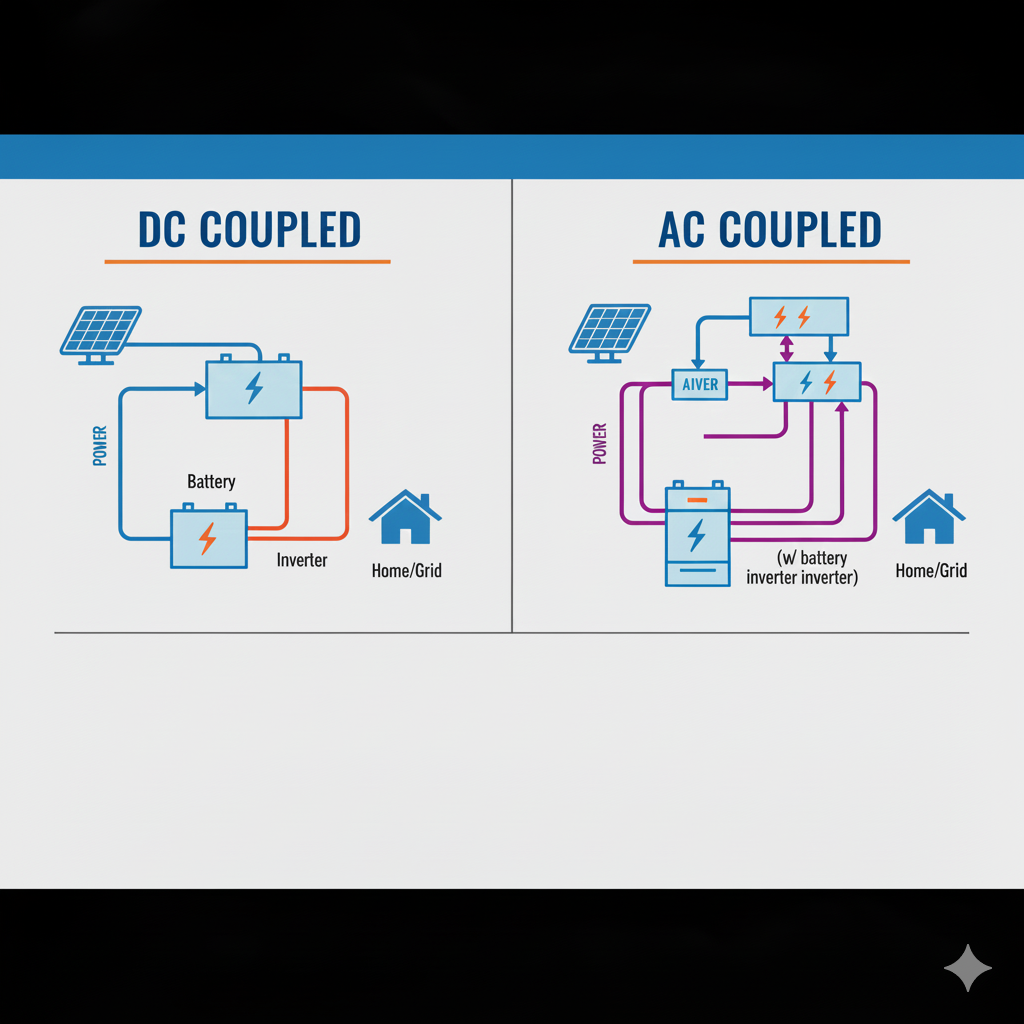
DC-coupled and AC-coupled batteries connect to solar systems in different ways. These differences create important trade-offs in efficiency, cost, retrofit flexibility, backup performance, and long-term savings.
With federal rebates favouring hybrid inverters and modular batteries becoming the standard, understanding coupling types is essential—especially for Melbourne and Victorian homes.
This guide explains how each system works, real-world performance, and which option makes sense in 2025.
How Solar + Battery Coupling Works
Solar panels produce DC electricity
Batteries store DC electricity
Homes use AC electricity
The coupling type determines how many conversions occur, which directly affects efficiency and energy loss.
DC-Coupled Systems (Hybrid Inverter Approach)
Energy Flow:
Solar Panels (DC) → Hybrid Inverter → Battery (DC) → Home / Grid (AC)
What this means:
Solar charges the battery directly on DC
Only one main conversion
Minimal energy loss
Key Advantage:
Higher efficiency and better future scalability.
AC-Coupled Systems (Separate Inverters)
Energy Flow:
Solar Panels (DC) → Solar Inverter → AC → Battery Inverter → Battery (DC) → AC to Home
What this means:
Solar converts to AC first
Battery converts AC back to DC
Power converts again when discharging
Key Advantage:
Works with existing solar systems without major changes.
Efficiency Comparison (Why It Matters)
Average Round-Trip Efficiency
DC-Coupled: 94–96%
AC-Coupled: 88–92%
A 4–6% efficiency gap can mean $200–$400 extra savings per year on a typical 13 kWh battery.
Real Melbourne Example (Winter Scenario)
6.6 kW solar produces ~15 kWh on a cloudy winter day
DC-coupled battery stores ~14.4 kWh
AC-coupled battery stores ~13.2 kWh
Difference:
1.2 kWh per day ≈ $0.66 at peak rates
≈ $240 per year lost with AC coupling
Result:
DC-coupled systems often pay for themselves in ~3 years from efficiency alone.
When You Should Choose DC-Coupled Batteries
Best Scenarios
New solar + battery installations
Replacing an old inverter
Planning future battery expansion
Maximising bill savings
Large homes (10 kW+ systems)
Popular DC-Coupled Combinations
Fronius Gen24 + BYD HVS
Sungrow Hybrid + BYD HVM
SolarEdge Hybrid + LG
SMA + Sonnen
Why homeowners choose DC:
Future-proof, expandable, and highest efficiency.
When AC-Coupled Batteries Still Make Sense
Best Scenarios
Existing solar inverter under 5 years old
Budget-focused retrofits
Keeping current solar warranty
Mixed solar brands or older systems
Rental or low-disruption installs
Popular AC-Coupled Batteries
Tesla Powerwall 3
Enphase IQ Battery
SolarEdge Home Battery
Generac PWRcell
Why homeowners choose AC:
Fast install, minimal disruption, works with almost any solar system.
Cost Comparison (After Rebates)
New Install Example
DC-Coupled (BYD + Fronius, 13 kWh): ~$8,050
AC-Coupled (Tesla Powerwall 3): ~$8,750
DC wins on lifetime value, AC wins on brand simplicity.
Retrofit Example
Existing 6.6 kW solar already installed
DC retrofit requires inverter replacement
AC retrofit adds battery only
AC saves $6,000+ upfront in most retrofits
Backup Power Performance
DC-Coupled Backup Advantages
Solar continues charging during blackouts
True islanding (no grid import)
Higher surge capacity
Better whole-home backup
AC-Coupled Backup Reality
Tesla Powerwall offers excellent switchover
Solar usually shuts down during outages
Backup limited by battery inverter rating
Winner:
DC for solar-during-blackouts
Tesla AC for simplicity and reliability
Hybrid Trend: Best of Both Worlds
Modern hybrid inverters now offer:
DC efficiency (up to 96%)
AC retrofit compatibility
Modular expansion
VPP readiness for Victoria
Example:
Sungrow Hybrid + BYD HVS
DC mode for new installs
AC mode for retrofits
Full rebate eligibility
Quick Decision Matrix
New solar + battery → DC-Coupled
Existing solar (under 5 years) → AC-Coupled
Maximum efficiency → DC-Coupled
Budget retrofit → AC-Coupled
Whole-home backup → DC or Tesla AC
Modular expansion → DC-Coupled
Installation & Disruption Comparison
DC-Coupled (New System)
Full system install over 1–2 days
Temporary solar downtime
AC-Coupled (Retrofit)
Battery added in 1–2 days
Solar keeps running
AC wins for 80% of retrofit homes.
Future-Proofing Your Investment
DC-Coupled Advantages
Easier solar expansion
Stack batteries as EVs arrive
Higher VPP earnings
Better resale value
AC-Coupled Limitations
Ongoing conversion losses
Less flexible for large upgrades
Lower long-term efficiency
Industry shift:
DC-coupled hybrids are becoming the new standard—even for retrofits.
Final Verdict
Have existing solar that still works well?
→ AC-coupled battery (Tesla, Enphase, SolarEdge)
Building new or upgrading seriously?
→ DC-coupled hybrid system
Golden Rule:
Always compare 10-year savings, not just upfront price.
Efficiency now matters more than ever.